

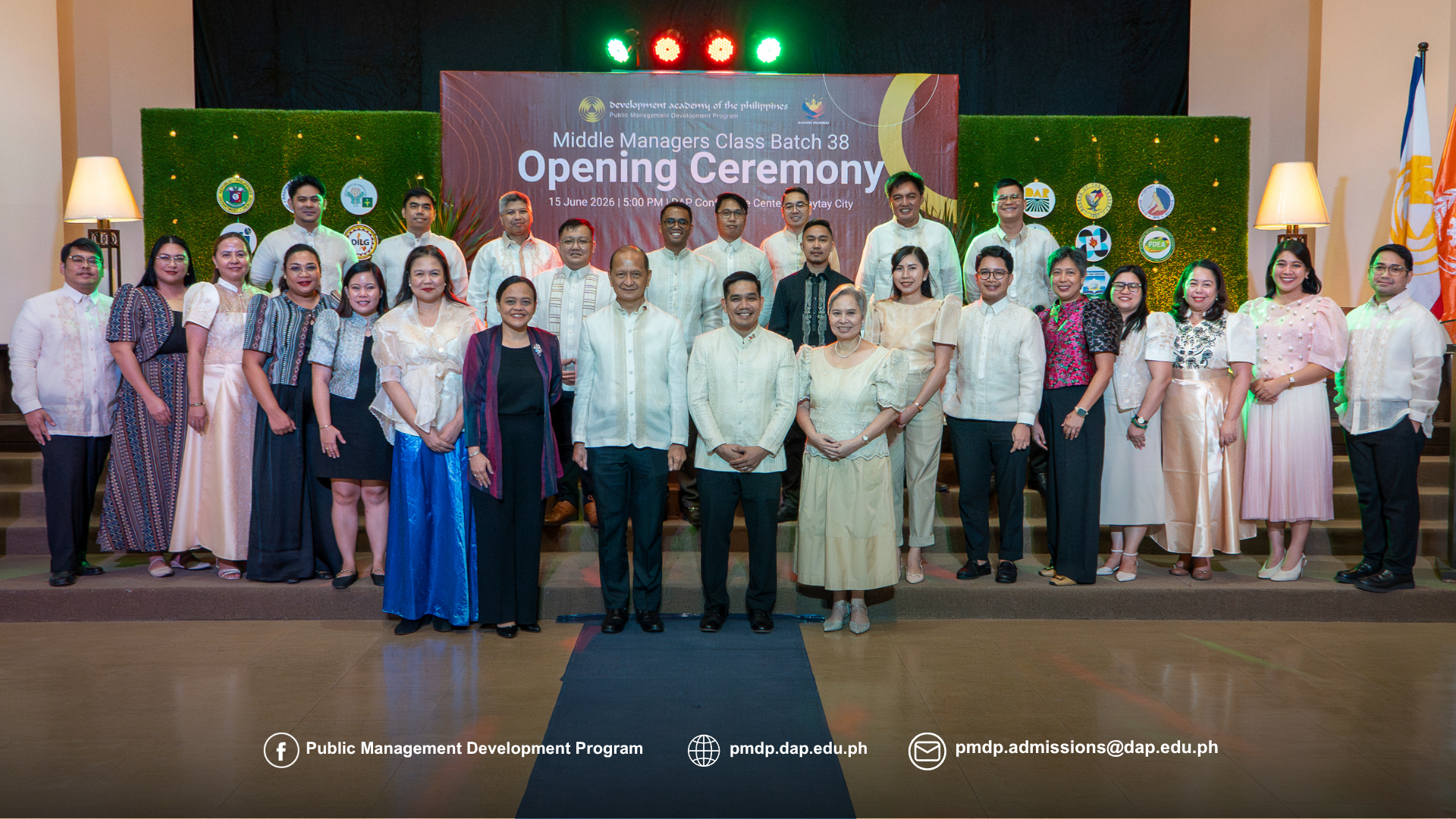
TAGAYTAY CITY, Cavite — Amid a rapidly evolving and increasing complex governance landscape , 22 newly admitted scholars were called to develop adaptive and action-oriented leadership as they begin their journey under the Development Academy of the Philippines (DAP) through its Public Management and Development Program (PMDP).
On Monday, 15 June 2026, the scholars from 17 government agencies were formally introduced during the Opening Ceremony of Middle Managers Class (MMC) Batch 38 at the DAP Conference Center.
In his opening remarks, DAP Acting President and CEO Dr. Leocadio S. Sebastian emphasized the need for leadership that can respond to compounding changes across the public sector.
“We are living through a period of compounding change—organizational restructuring, technological disruption, rising citizen expectations, and fiscal constraints,” Dr. Sebastian said. “The public sector faces a relentless stream of pressures that reshape how the government operates and redefine what it must deliver.”
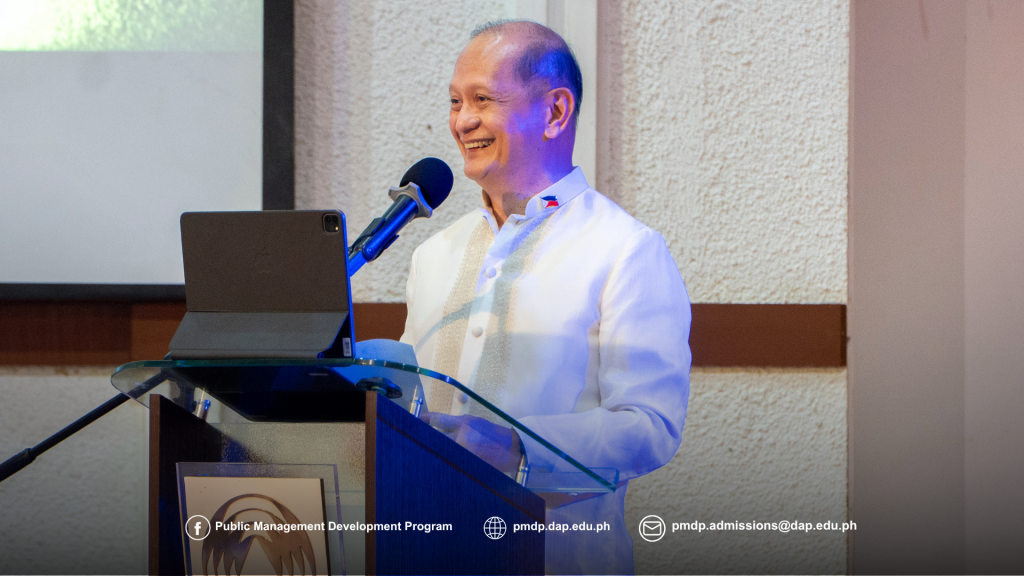
DAP Acting President and CEO Dr. Leocadio S. Sebastian welcomed the newest batch of Middle Managers Class in his opening remark at DAP Conference Center on Monday, 15 June 2026.
He stressed that the challenge in governance often lies not in policy design but in execution.
“More often, we falter at the point of implementation—the gap between intent and action at the operational level,” he said.
Dr. Sebastian also pointed to the tendency of institutions to remain in pilot stages, stressing the importance of scaling successful initiatives.
“We have many good ideas, projects, and successful pilot efforts—but that’s it. Pilot after pilot,” he said. “Don’t pilot. We need to scale. Expand. That is the gap that we need to fill.”
He further highlighted that sustainable transformation, particularly in digital governance, requires more infrastructure.
“It requires adaptable governance and a workforce prepared for change,” he noted.
Central to his message was the critical role of middle managers in driving meaningful reform within institutions.
“As middle managers, you occupy the most critical level of action. You are not just administrators or supervisors—you are change agents. You make reforms real, operational, and doable,” Dr. Sebastian said.
The Opening Ceremony was graced by Dr. Sebastian, Acting Executive Vice President and Senior Vice President for Programs Magdalena L. Mendoza, Center for Career Executive Service Development Vice President Myda A. Nieves, and MMC Batch 38 Class Director Cecilia A. Belda.
The scholars were formally welcomed through a rite of inclusion highlighted by a ceremonial activity where they placed their agency logos on a designated board, symbolizing their entry into the program and their commitment to serving the public.

Roel M. Dela Cruz, among the newest scholars of the Middle Managers Class, ceremonially placed the Philippine Space Agency’s logo—his mother agency—on stage during the Rite of Inclusion, signifying his formal entry into the program.
Fertilizer and Pesticide Authority Executive Director III Glenn DC. Estrada, alumnus of MMC Batch 28 – Hiraya delivered an inspirational message, encouraging scholars to embrace uncertainty, growth and leadership driven by purpose.
“Whenever you find yourself asking, ‘Am I ready for this? Do I really belong here?’ Remember that you are here because someone believed in you. That someone saw your potential, your capacity to lead, and your readiness to grow,” he said.
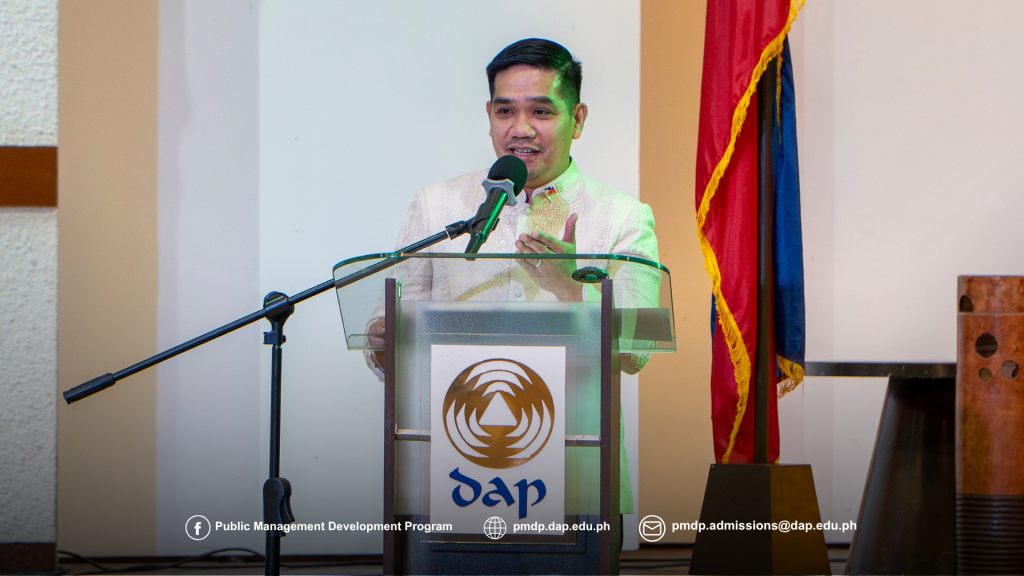
Fertilizer and Pesticide Authority Executive Director III Glenn DC. Estrada, alumnus of MMC Batch 28 – Hiraya delivered an inspirational message to MMC Batch 38.
Reflecting on his own PMDP journey, Mr. Estrada emphasized that leadership goes beyond technical expertise and positional authority.
“Allow yourself to unlearn the idea that leadership means having all the answers, the habit of working alone, and the fear of asking questions. Give yourself the chance to be mentored, to be corrected, and to learn from others,” he said.
Highlighting the value of collaboration across institutions, he stressed that governance is a shared responsibility.
“No single agency, no single leader can solve complex problems alone,” Mr. Estrada said. “You will discover how different systems and leadership cultures can work together toward a common goal.”
Mr. Estrada encouraged scholars to anchor their work on purpose and conviction, especially when facing challenges.
“When the work becomes difficult, and it will, you will need more than compliance to continue. You will need conviction and a support system,” he said.
He concluded by urging the scholars to remain resilient and committed to meaningful change in public service.
“Break the walls that say, ‘This is how it has always been done.’ Break the walls that say, ‘Change is impossible,’” he said. “Take the difficult path, because the only real failure is never trying.”
Throughout the program, scholars are expected to engage with real-world challenges, collaborate with peers across sectors, and develop solutions that can be applied within their respective institutions.
The PMDP community now includes 2,220 graduates from 276 agencies nationwide, forming a network of public servants committed to strengthening institutions and improving public service delivery.
Prior to the formal ceremony, the incoming cohort was greeted by MMC Batch 37 – Ani in a “salubong” activity that allowed both batches to meet and engage in informal introductions and exchanges.

MMC Batch 38 gathers with MMC Batch 37, DAP Acting President Dr. Leocadio Sebastian, Acting Vice President and Senior Vice President for Programs Magdalena L. Mendoza, and the Center for CES Development team for a commemorative photo.