

PASIG CITY — What makes a government system efficient—and can those lessons be applied in the Philippines?
Senior Executives Class (SEC) alumni of the Public Management Development Program (PMDP) explored this question during a webinar titled “From Asian Practice to Philippine Reform: Insights from PMDP Foreign Study Mission” on Thursday, 14 May 2026, organized by the Development Academy of the Philippines (DAP) through the Center for CES Development (CCD).
The webinar was open to the general public and drew a total of 91 online participants, including representatives from government agencies, the private sector, and students, with registrants coming from 75 agencies and organizations.
In his opening remarks, DAP Acting President and Chief Executive Officer Dr. Leocadio S. Sebastian emphasized that governance must continuously evolve amid rapid technological disruption, climate risks, inequality and declining public trust.
He said public service can no longer focus only on delivery. Institutions, he noted, must become more responsive and centered on citizens, not just processes.
“The Foreign Study Mission is not simply an academic requirement or an international exposure activity. It is an investment in the future of Philippine governance,” Dr. Sebastian said, noting that such programs challenge leaders to rethink how institutions are designed and how reforms are implemented.
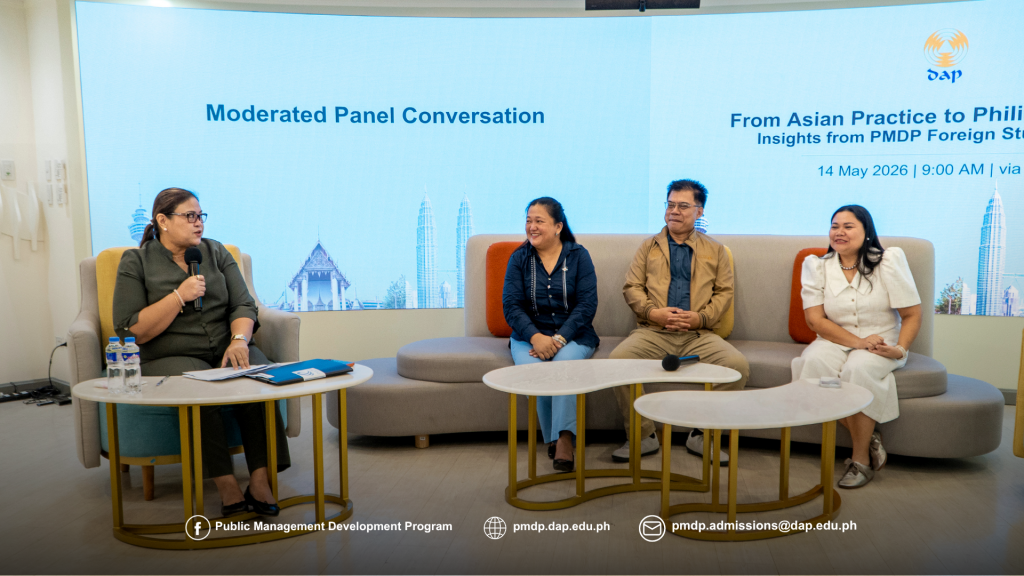
(From L-R: Atty. Noreen Bernadette Sta. Luis-Lutey, Dr. Ronnalee N. Orteza, Atty. Rodolfo B. del Rosario, Jr. and Atty. Racquel D.R. De Guzman Buensalida) Exchange of insights among the presenters during the panel discussion on the Foreign Study Mission.
The session featured reflections from PMDP alumni who shared key takeaways from their foreign study missions across Asia—specifically Thailand, Singapore, Malaysia, and South Korea—highlighting governance practices, institutional innovations, and leadership approaches that may inform public sector reform in the Philippines. The panel discussion was moderated by PMDP alumna Atty. Noreen Bernadette S. San Luis-Lutey of SEC Batch 11 – GaBayAni, now Vice President for Road Traffic Safety and Quality, Environment, Safety, and Health of North Luzon Expressway Corp.
Thailand: Why execution matters as much as strategy
Dr. Julius L. Leaño, Jr. (SEC 14 – Buklod-Tala), Executive Director of the Philippine Textile Research Institute, who had his foreign study mission in Thailand, highlighted the country’s “whole-of-government” approach to digital transformation—anchored on long-term planning, institutional alignment, and sustained investments in digital infrastructure and innovation.
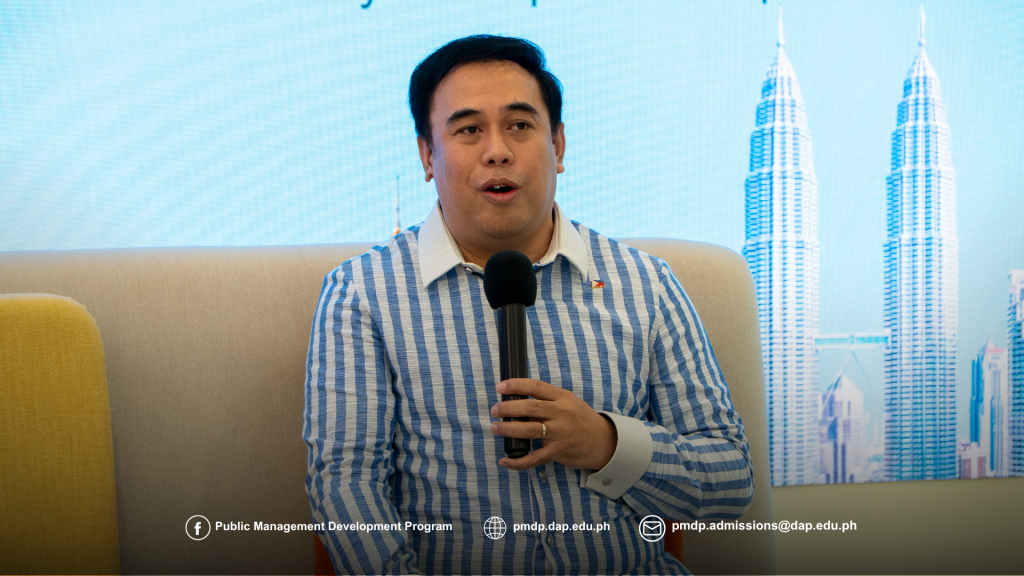
Dr. Julius L. Leaño, Jr. delivered his presentation on his foreign study mission in Thailand, emphasizing the country’s focus on policy integration.
He said Thailand’s strength was aligned with a long-term national direction. Implementation was treated as seriously as planning.
“Thailand’s strategy has looked at policy integration, digital literacy and inclusion, industry collaboration, performance tracking, and continuous research and technology readiness,” he added.
Singapore: The power of clarity, data, and political will
For his part, Atty. Rodolfo B. Del Rosario, Jr. (SEC 8 – Awanggan), Division Chief of the Litigation Office at the Anti-Red Tape Authority, who undertook his study mission in Singapore, said his experience highlighted the value of clear direction supported by strong systems.
He described a governance model anchored on leadership continuity and integrated digital systems that make public service delivery more efficient and predictable.
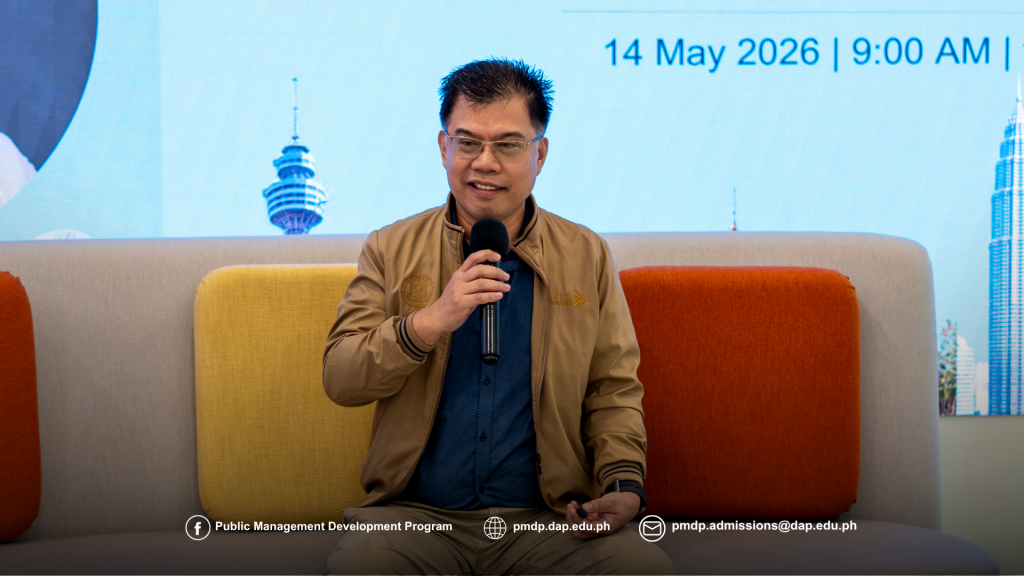
Atty. Rodolfo B. Del Rosario, Jr. shared insights about his learnings from his foreign study mission in Singapore, where he stressed the power of clarity, data, and political will.
He stressed that reform was not only technical. It was also a political will sustained over time.
“The challenge is not whether the Philippines can become like Singapore. The challenge is whether we are willing to govern with the same seriousness and commitment to the public good,” he emphasized.
Malaysia: Reform works better when everyone was aligned
Governance reform, as Atty. Racquel D.R. De Guzman-Buensalida (SEC 13 – Katig), Senior Vice President of the Government Service Insurance System, observed from Malaysia’s public systems, was rooted in coordination rather than fragmentation.
She said reforms work better when agencies, policies, and stakeholders were moving in the same direction, instead of operating in silos. She pointed to Malaysia’s investments in skills development and digital transformation as part of its broader development strategy.
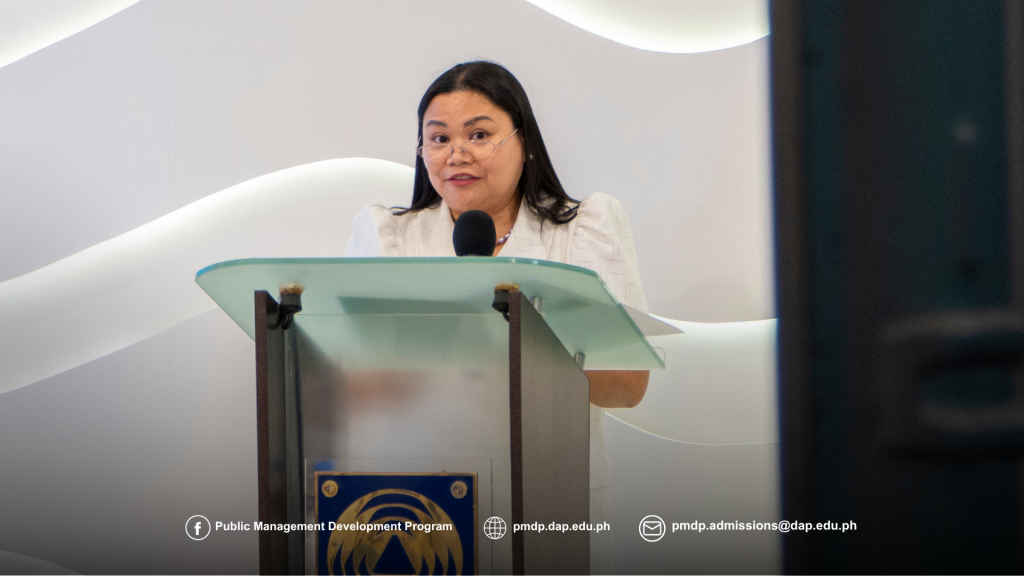
Atty. Racquel D.R. De GuzmanAtty. Racquel D.R. De Guzman-Buensalida took the stage to share her learnings from her study mission in Malaysia, stressing the importance of realignment when it comes to reforms.
“Stakeholder buy-in and acceptance are essential for the success of government programs,” she noted.
She also proposed the creation of a Philippine Productivity Corporation to drive innovation while strengthening businesses support and enhancing national competitiveness.
South Korea: Turning vision into systems that last
Meanwhile, Dr. Ronalee N. Orteza (SEC Shuttle Course Batch 1 – Optimus), Executive Director of the Philippine Science High School System who focused her study mission in South Korea, said the country’s progress was the result of sustained and disciplined reform.
She traced the country’s transformation from post-war recovery to industrial power, driven by long-term state direction and strong institutional systems.
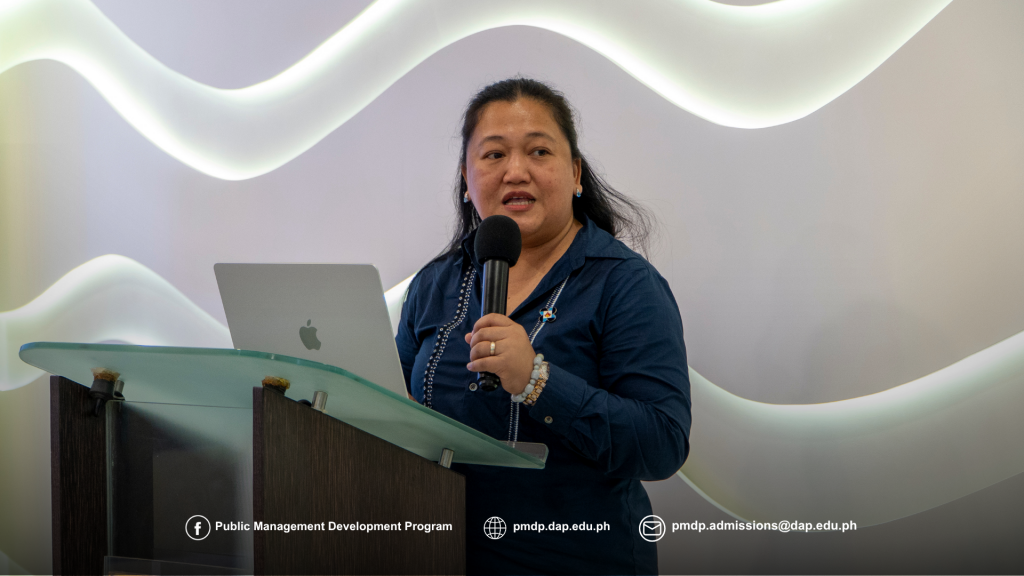
Dr. Ronnalee N. Orteza presented her insights from her foreign study mission in South Korea, pointing to the country’s sustained and disciplined reform efforts.
For her, the key lesson was not just reform design, but reform continuity. Without alignment across leadership, systems, and citizens, even good policies weaken over time.
“The challenge is not about the absence of reforms, but the lack of integration among them,” she stressed.
The session was capped by a closing remark from DAP Acting Executive Vice President and Senior Vice President for Programs Magdalena Mendoza, who emphasized the importance of translating global insights into concrete, actionable reforms within Philippine institutions.
“We learn, we try to transfer what we have learned, and we probably need to do better—not just to compete with other countries, but to provide the quality of governance that the Filipino people deserve,” she said.
Across the webinar, the PMDP alumni underscored a shared insight: Meaningful governance reform is not about copying other countries’ systems, but about making reforms work within local realities.
The Foreign Study Mission (FSM) is one of the core learning methodologies of the PMDP curriculum, enabling SEC scholars to directly observe, examine, and benchmark policy innovations, governance systems, and leadership practices in selected Asian countries that may inform and enrich Philippine public sector reforms.
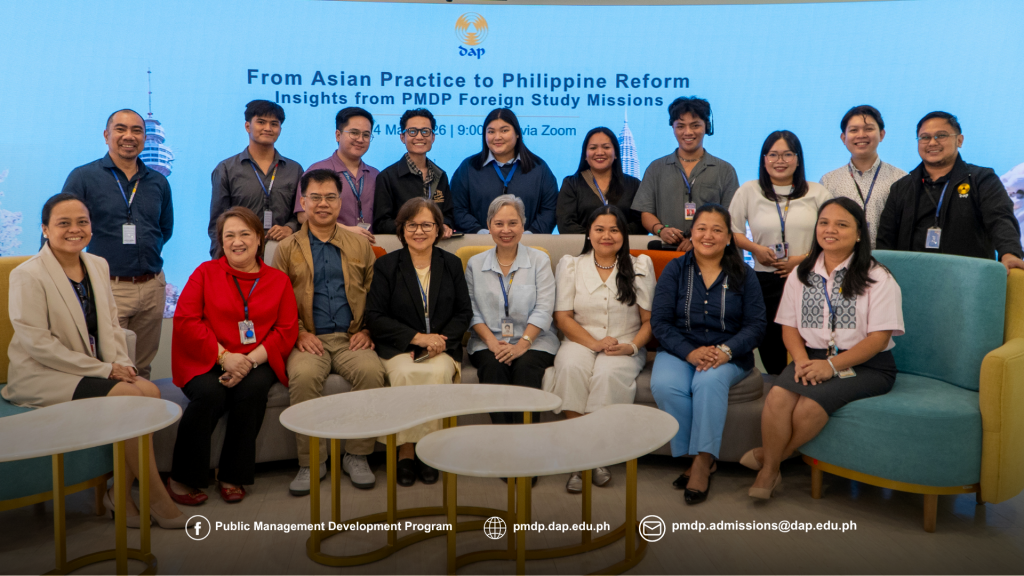
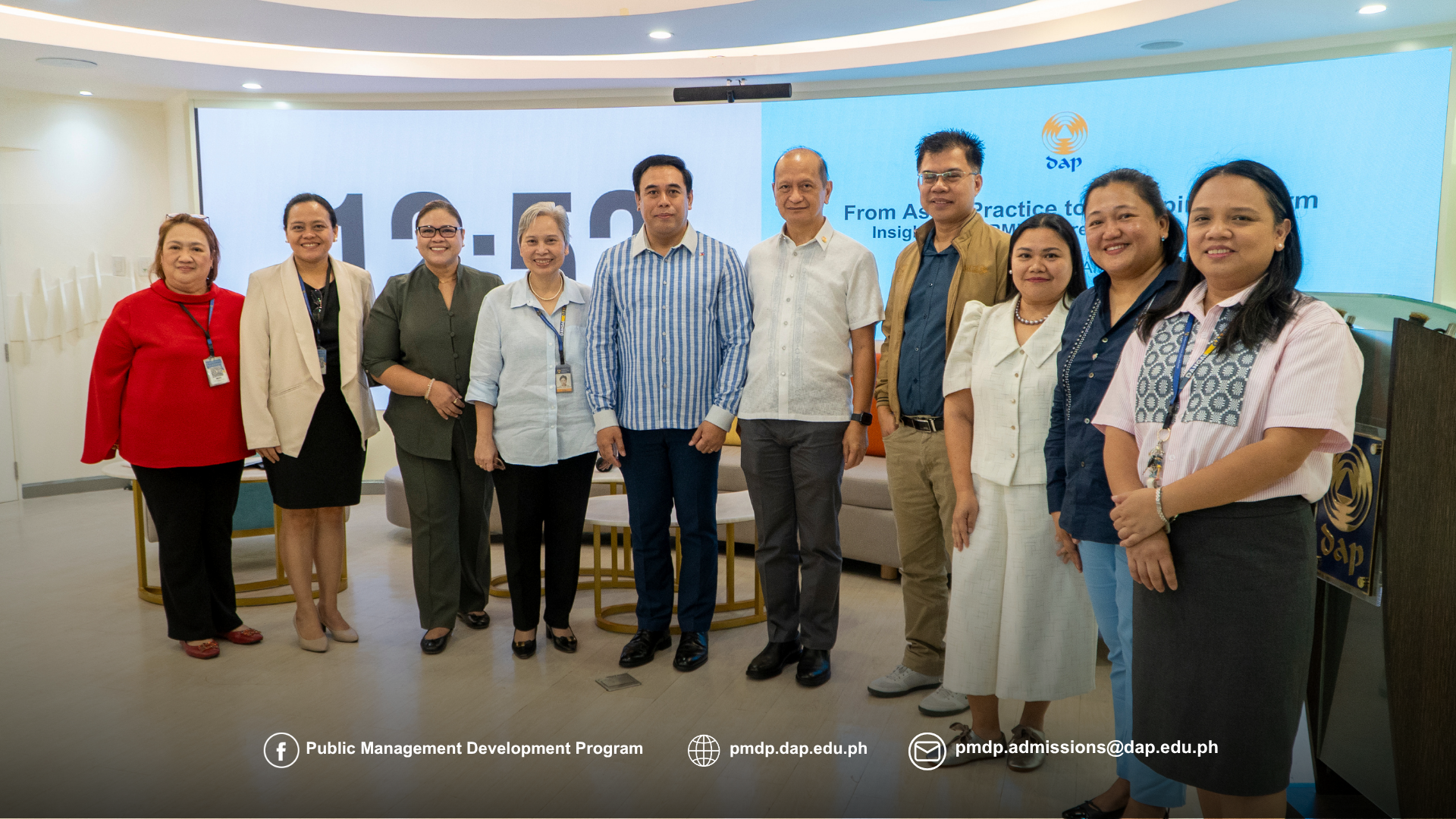
Acting Executive Vice President and Senior Vice President for Programs Magdalena Mendoza (5th from the left, 1st row); Senior Vice President for Services Lawrence V. Madriaga (1st from the left, 2nd row); former CCD Vice President Nanette Caparros (4th from the left, 1st row); incumbent CCD Vice President Myda A. Nieves (1st from the left, 1st row); AAO Director Carmelita F. Young (2nd from the left, 1st row); SEDO Director Sheryl B. Reyes (8th from the left, 1st row); and the PMDP team pose for a group photo with the presenters and moderator to cap off the Foreign Study Mission at the IGH Multi-Media Room, DAP Pasig, on 14 May 2026.